Case Study - Developer Portfolio
A modern, interactive developer portfolio built with Next.js 13, featuring a VS Code-inspired design, animated components, dark theme, MDX-powered project pages, contact form integration, and comprehensive skills showcase with smooth animations.
- Industry
- Personal Branding
- Year
- Service
- Personal Portfolio Website
About
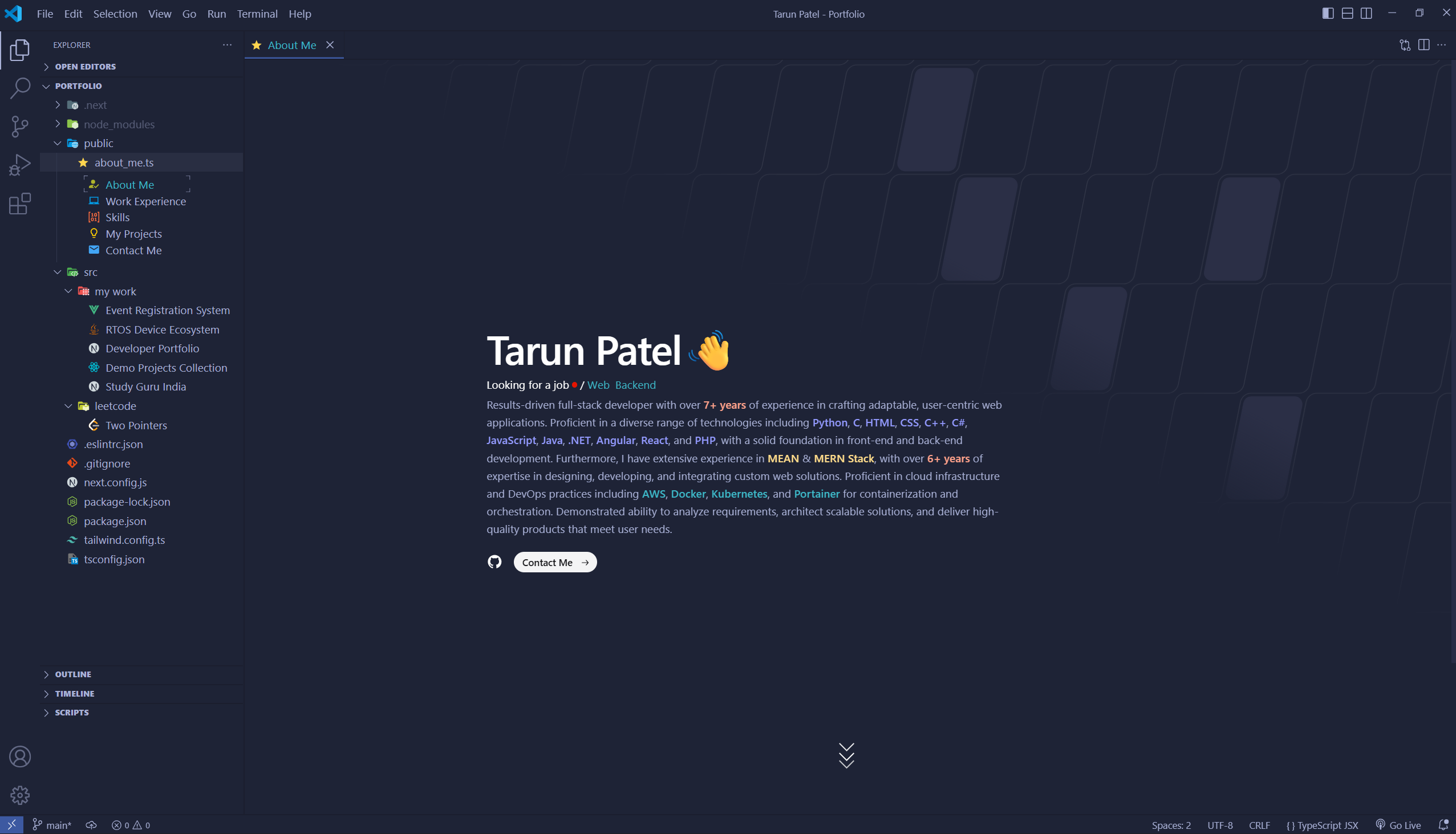
This Developer Portfolio is a modern, feature-rich personal website designed to showcase my professional experience, technical skills, and project portfolio in an engaging and interactive manner. The portfolio is built with Next.js 13 using the App Router, featuring a unique VS Code-inspired design that immediately resonates with developers and technical recruiters, creating a memorable first impression.
The entire application is designed as a single-page experience with smooth scrolling navigation, complemented by dedicated MDX-powered project pages that provide detailed case studies for each showcased project. The design philosophy emphasizes user experience, incorporating subtle animations, interactive elements, and responsive layouts that adapt seamlessly to any device.
As both the designer and developer of this portfolio, I focused on creating a platform that not only displays my work effectively but also serves as a testament to my frontend development skills. Every component, animation, and interaction was carefully crafted to demonstrate proficiency in modern React patterns, state management, and UI/UX design principles.
Platform Highlights
- VS Code-Inspired Interface: Authentic code editor aesthetic with activity bar, explorer panel, tabs, and status bar
- Interactive Particle Background: Mesmerizing star-field animation using tsparticles for visual depth
- 3D Glow Cards: Mouse-tracking perspective transforms with gradient glow effects for project showcases
- Animated Skill Categories: Interactive skill section with staggered fade-in animations and category filtering
- MDX-Powered Project Pages: Rich content pages with code highlighting and custom components
- Integrated Contact System: Postmark-powered email delivery for seamless communication
- Redux State Management: Centralized navigation and UI state with Redux Toolkit
- Framer Motion Animations: Sophisticated scroll-triggered and interaction-based animations throughout
Technologies
Technology Stack
The portfolio is built on a cutting-edge technology stack optimized for performance, developer experience, and visual appeal:
Frontend Framework
- Next.js 13 with App Router for optimized rendering and routing
- React 18 with Server and Client Components
- TypeScript for type-safe development
- TailwindCSS with custom theme configuration
Animation & Interactivity
- Framer Motion for complex animations and transitions
- tsparticles for background particle effects
- Custom 3D perspective transforms for glow cards
State Management & Data
- Redux Toolkit for centralized state management
- React-Redux hooks for component integration
- MDX for rich content project pages
Backend & Integration
- Next.js API Routes for serverless functions
- Postmark for transactional email delivery
- Vercel Analytics for performance monitoring

NextJS

ReactJS

TypeScript

TailwindCSS

Redux

HTML5

CSS3

NodeJS

Git

GitHub

Postmark
Key Features
VS Code-Inspired User Interface
Authentic IDE Experience
The portfolio replicates the familiar VS Code interface that developers use daily, creating an immediate sense of familiarity and professionalism. The interface includes a fully functional Activity Bar with collapsible explorer panel, Top Bar with menu items and window controls, Tab Container for navigation between sections, and Bottom Status Bar displaying contextual information.
Collapsible Navigation System
The explorer panel features nested, collapsible menus organized into logical sections: Portfolio (main sections), Apps (project case studies), and Leetcode solutions. Users can expand and collapse sections just like in a real IDE, with smooth animations and proper state persistence through Redux.
Theme & Visual Design
The dark theme color palette (#1E2336 background, #A9B1D6 text) mirrors VS Code's Tokyo Night theme, creating a comfortable viewing experience for extended browsing. Custom accent colors distinguish different sections: green for About Me, orange for Work Experience, purple for Skills, and yellow for Projects.
Interactive Components & Animations
3D Glow Cards
Project and education cards feature sophisticated mouse-tracking with perspective transforms that create a subtle 3D tilting effect. A radial gradient glow follows the cursor position, creating an engaging interactive experience that invites exploration.
Animated Title Typewriter
The hero section features a dynamic typewriter animation cycling through "Web Frontend", "Web Backend", "Mobile", and "Software Development" - showcasing the breadth of skills using Framer Motion's staggered letter animations.
Star Particle Background
Multiple sections feature an animated star-field background using tsparticles, adding visual depth without overwhelming the content. The particles move slowly and subtly, creating a professional yet engaging atmosphere.
Fade-In Scroll Animations
Content elements fade in as they enter the viewport with configurable stagger delays, creating a polished reveal effect that guides the user's attention through the page.
Skills Showcase System
Category-Based Filtering
The skills section features an interactive category picker with eight distinct categories: Languages, Frontend, Backend, DevOps, Cloud, Database, Mobile, and Tools. Clicking a category triggers an animated transition to display the relevant technology logos with their names.
Staggered Grid Animations
Skill logos animate in with a staggered fade effect using Framer Motion's animation controls, creating a visually appealing reveal each time the category changes. The responsive grid adapts from 3 columns on mobile to 8 columns on large screens.
Project Portfolio & Case Studies
MDX-Powered Project Pages
Each project has a dedicated page built with MDX, allowing rich content mixing Markdown with React components. Pages include About sections, technology stacks with logo grids, key features, challenges faced, solutions implemented, and project impact.
Dynamic Project Loading
Projects are loaded dynamically using glob patterns and MDX imports, making it easy to add new projects without modifying component code. The system automatically generates navigation entries and metadata.
Contact Form & Integration
Seamless Email Delivery
The contact form collects name, email, company, and message, sending submissions via a Next.js API route to Postmark for reliable email delivery. Toast notifications provide immediate feedback on submission status.
Technical Challenges & Solutions
Challenge 1: VS Code Interface Replication
The Problem: Creating an authentic VS Code-like interface that feels familiar to developers while maintaining full responsiveness across all device sizes, from mobile phones to ultra-wide monitors.
The Solution: Built a modular component architecture separating the TopBar, ActivityBar, CollapsableMenu, TabsContainer, and BottomBar into independent, reusable components. Used TailwindCSS container queries (@container) for responsive layouts within components, and implemented a Redux-based state management system to synchronize the collapsible sidebar state across all breakpoints. The mobile experience gracefully degrades to a hamburger menu while maintaining the IDE aesthetic.
Challenge 2: Smooth 3D Card Interactions
The Problem: Implementing the 3D glow card effect with perspective transforms that feels natural and responsive, without performance issues or jarring movements.
The Solution: Leveraged Framer Motion's useMotionValue and useMotionTemplate hooks to create smooth, GPU-accelerated transforms. The mouse position is tracked relative to each card's bounding box, converted to rotation angles, and applied through CSS perspective transforms. An interval-based reset function smoothly returns cards to neutral position when the mouse leaves, preventing abrupt snapping.
Challenge 3: Complex Animation Orchestration
The Problem: Coordinating multiple animations including the typewriter effect, staggered fade-ins, skill category transitions, and particle backgrounds without causing performance issues or visual conflicts.
The Solution: Implemented animation controls using Framer Motion's useAnimationControls hook for programmatic animation triggering. The typewriter animation uses a recursive async function with sleep delays, ensuring proper sequencing. Staggered animations use viewport intersection observers to trigger only when elements are visible, reducing unnecessary calculations.
Challenge 4: MDX Integration with Next.js 13 App Router
The Problem: Integrating MDX content with Next.js 13's App Router while maintaining type safety, dynamic imports, and custom component support across all project pages.
The Solution: Configured @next/mdx with custom component mappings, allowing MDX files to use React components like FadeIn, Border, and Section. Dynamic section loading uses glob patterns to discover MDX files and extract their exported sections and metadata, building a centralized navigation structure at build time.
Challenge 5: Responsive Skills Grid with State Persistence
The Problem: The skills section needed to display varying numbers of items per category while maintaining consistent grid layouts and remembering the selected category across re-renders.
The Solution: Used React state with Framer Motion animation controls to manage category selection. The grid layout adapts using TailwindCSS responsive classes, while empty placeholder items maintain grid alignment. Animation controls allow for coordinated hidden/visible transitions when categories change.
Solution
This Developer Portfolio delivers a unique, memorable web experience that showcases professional skills and projects through an innovative VS Code-inspired interface. The solution combines cutting-edge frontend technologies with thoughtful design to create a portfolio that stands out.
Architecture & Performance
The application leverages Next.js 13's App Router for optimal rendering performance, combining Server Components for static content with Client Components for interactive features. The modular component architecture ensures maintainability while the CSS-in-JS approach with TailwindCSS provides consistent styling across the application.
Redux Toolkit manages global state including sidebar expansion, active menu selection, and section navigation. This centralized approach ensures consistent behavior across all components while the Redux DevTools integration aids development and debugging.
Visual Design & Branding
The VS Code-inspired interface immediately establishes credibility with technical audiences, while the dark theme reduces eye strain and creates a professional atmosphere. Custom accent colors (green, orange, purple, yellow) distinguish different sections while maintaining visual harmony.
The 3D glow cards and particle backgrounds add depth and interactivity without overwhelming the content. Every animation is carefully tuned to be subtle yet impactful, enhancing the user experience rather than distracting from it.
Content Management
MDX integration enables rich content creation for project case studies, combining the simplicity of Markdown with the power of React components. New projects can be added by creating an MDX file and optionally adding an entry to the projects array - no complex CMS required.
User Experience
The single-page design with smooth scrolling creates a cohesive browsing experience, while dedicated project pages provide space for detailed case studies. The contact form with Postmark integration ensures reliable message delivery, while toast notifications provide immediate feedback.
Project Impact
Professional Presentation
The portfolio successfully presents a comprehensive professional profile, showcasing 7+ years of experience across frontend, backend, DevOps, cloud, and mobile technologies. The organized structure allows visitors to quickly find relevant information while the detailed project pages provide depth for interested parties.
Technical Demonstration
Beyond displaying project information, the portfolio itself serves as a demonstration of technical skills. The VS Code interface, 3D animations, Redux state management, and MDX integration showcase proficiency in modern React development patterns and libraries.
User Engagement
The interactive elements - from the particle backgrounds to the glow cards to the animated skill transitions - encourage exploration and increase time on site. The familiar IDE interface creates an immediate connection with developer audiences, fostering engagement and memorability.
Accessibility & Performance
The responsive design ensures the portfolio is accessible across all devices, from mobile phones to desktop monitors. The dark theme and carefully chosen color contrasts maintain readability, while the optimized animations ensure smooth performance even on lower-powered devices.
Extensibility
The modular architecture and MDX-based content system make it easy to add new projects, update information, and extend functionality. The portfolio is designed to grow alongside career progression, serving as a long-term professional asset.