Case Study - Intranet Application
A comprehensive full-stack enterprise intranet platform designed for internal communication, knowledge management, and employee engagement, featuring microservices architecture, real-time capabilities, and distributed file storage.
- Industry
- Enterprise Software & Internal Communications
- Year
- Service
- Enterprise Intranet Platform
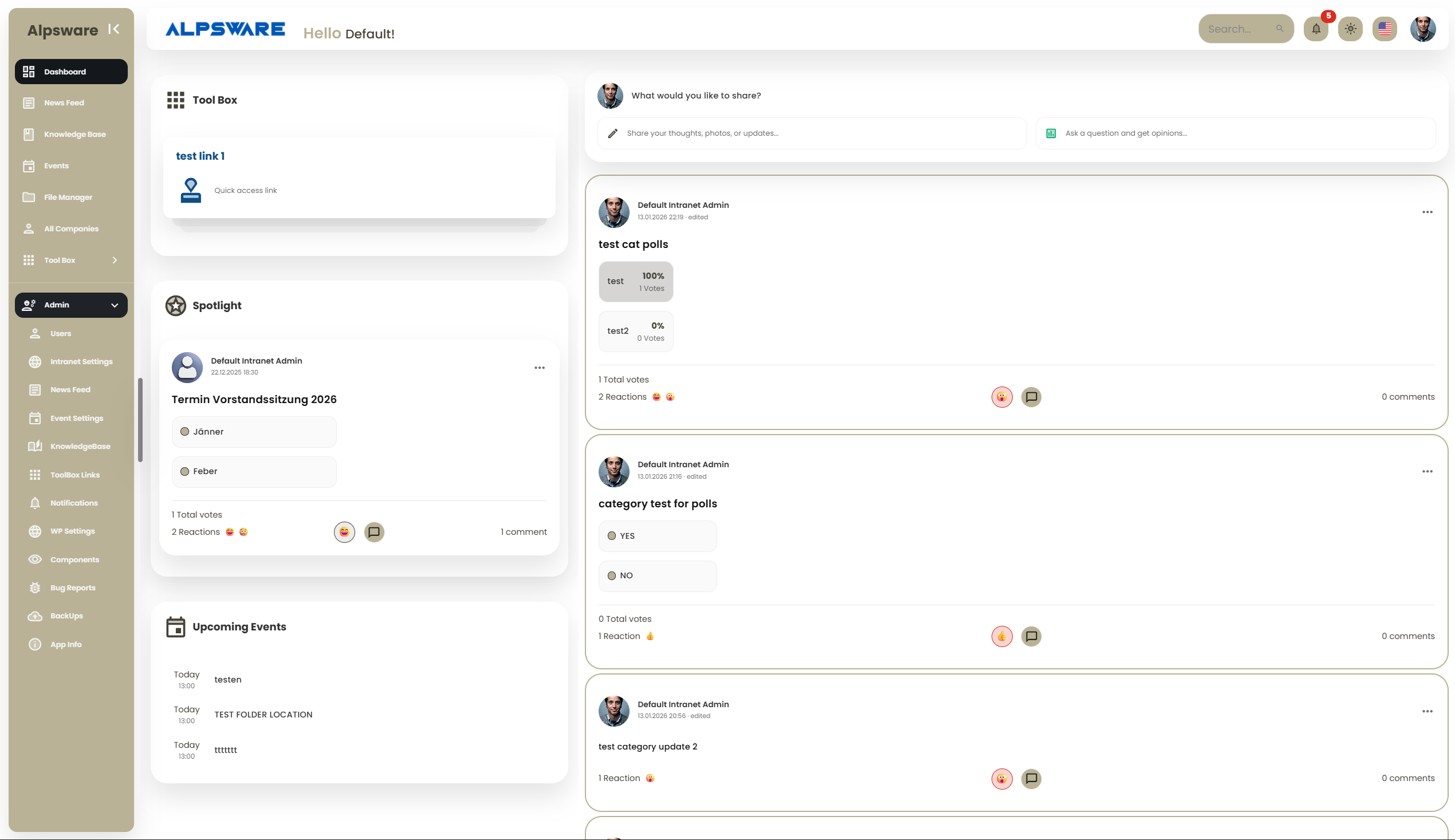
About the Platform
The Enterprise Intranet Application is a sophisticated full-stack platform engineered to revolutionize internal corporate communication, knowledge management, and employee engagement. Built with modern microservices-oriented architecture, this enterprise-grade solution seamlessly integrates real-time communication capabilities, robust authentication systems, and distributed file storage to create a unified digital workplace experience.
Platform Overview
This comprehensive intranet platform serves as the central hub for organizational communication and collaboration, providing employees with a feature-rich environment for sharing information, managing events, accessing knowledge resources, and staying connected with colleagues across the organization. The system is designed to handle enterprise-scale deployments with thousands of concurrent users while maintaining exceptional performance and reliability.
Core Capabilities
Real-Time Communication Infrastructure: The platform leverages SignalR with WebSocket technology to deliver instant notifications, live updates, and real-time collaboration features. Users receive immediate notifications for posts, comments, reactions, events, and mentions, creating an engaging and responsive user experience that keeps teams connected and informed.
Enterprise Authentication & Security: Implementing a dual authentication system that supports both local credentials and LDAP integration, the platform seamlessly connects with existing enterprise directory services. The security architecture includes JWT-based authentication with 6-month token expiration, automatic refresh mechanisms, BCrypt password hashing, and comprehensive Role-Based Access Control (RBAC) with over 50 granular permission keys.
Distributed File Management: Integration with SeaweedFS provides a scalable, distributed file storage solution capable of handling millions of files. The system implements JWT-based file access control, automatic image optimization with thumbnail generation, file deduplication using SHA-256 hashing, and organized storage structures for profile pictures, cover photos, post attachments, and knowledge base documents.
Rich Content Management: Powered by the TipTap rich text editor, the platform offers sophisticated content creation capabilities with support for blockquotes, code blocks, tables, resizable images, and custom styling. The content management system includes category organization, spotlight features for important content, user mentions and tagging, and multi-language support for global organizations.
Multi-Channel Notification System: A comprehensive notification infrastructure delivers messages through multiple channels including in-app notifications, email via MailKit, and SMS integration. Users can customize their notification preferences with frequency controls (instant, daily, weekly), and the system processes scheduled notifications through background worker services.
Technical Architecture
The platform is built on a modern technology stack featuring .NET 8.0 Web API for the backend with MongoDB as the primary database, and React 18.3.1 with TypeScript for the frontend. The architecture follows industry best practices including dependency injection, repository pattern, DTO pattern, and service layer architecture, ensuring maintainability, scalability, and code quality.
Enterprise Integration
The intranet seamlessly integrates with existing enterprise systems including LDAP/Active Directory for user authentication and group management, WordPress CMS for content synchronization, email servers via SMTP, and SMS providers for multi-channel communication. This integration capability ensures the platform fits naturally into the existing IT ecosystem without requiring major infrastructure changes.
User Experience
The responsive user interface, built with Bootstrap 5.3 and Tailwind CSS, provides a modern, intuitive experience across all devices. Features include dark/light theme switching, internationalization support for multiple languages (English, German), interactive calendars for event management, data visualization with charts and graphs, and a comprehensive dashboard for quick access to important information and metrics.
Technologies
.NET 8.0
C#

React 18

TypeScript

MongoDB

Redux Toolkit

Bootstrap 5

Tailwind CSS

Sass
Docker

Swagger

Git
Backend Technologies
.NET 8.0 Web API: Built on the latest .NET framework leveraging modern C# features, async/await patterns, and performance optimizations. ASP.NET Core provides RESTful API architecture with dependency injection, middleware pipeline, and comprehensive error handling.
MongoDB 3.0.0: NoSQL document database with 30+ collections including Users, Roles, Permissions, Posts, Events, Notifications, and Knowledge Base. Custom aggregation pipelines for complex queries, database migration system with versioning, and automated schema updates.
Authentication & Security: JWT (JSON Web Tokens) for stateless authentication with 6-month token expiration and automatic refresh. LDAP Integration using System.DirectoryServices.Protocols for enterprise directory authentication. BCrypt.Net for password hashing with salt. Role-Based Access Control (RBAC) with 50+ granular permission keys.
SignalR: WebSocket-based real-time communication with fallback to long polling. Custom NotificationHub with group-based messaging for user groups, post groups, and event groups. Connection management with automatic reconnection and heartbeat monitoring.
SeaweedFS Integration: Distributed file system for scalable file storage with JWT-based file access control. Image processing using SixLabors.ImageSharp for thumbnail generation and optimization. File deduplication using SHA-256 hashing.
MailKit 4.3.0: SMTP email service with template support and HTML rendering. Template engine for dynamic email/SMS content with variable substitution. Scheduled notification system with background service workers.
Additional Backend: Swagger/OpenAPI for comprehensive API documentation. Serilog for structured logging with multiple sinks. Health Checks for MongoDB monitoring. Response Compression for optimized data transfer. SSH.NET for secure file transfer and remote server management.
Frontend Technologies
React 18.3.1 & TypeScript: Modern React with hooks, concurrent features, and Strict Mode. Full type safety across the application with strict mode enabled. React Router 6.27.0 for client-side routing with protected routes and lazy loading.
State Management: Redux Toolkit 2.6.1 for centralized state management with slices and async thunks. React Context API for theme context, authentication context, and appearance context. Custom hooks for state synchronization and side effects.
UI Framework: Bootstrap 5.3.3 for responsive grid system and component library. Tailwind CSS 3.4.1 for utility-first styling. SASS 1.80.4 for CSS preprocessing with modular architecture. DaisyUI 4.7.2 for Tailwind CSS components. Framer Motion 12.6.2 for animations and transitions.
TipTap 2.12.0: Extensible rich text editor built on ProseMirror with custom extensions for blockquotes, code blocks, tables, images, and links. Resizable images and tables with custom styling. Real-time content updates and autosave functionality.
SignalR Client: @microsoft/signalr 8.0.0 for WebSocket connections with custom connection service and automatic reconnection logic. Exponential backoff retry strategy (up to 5 attempts). Group subscription management for posts, events, and user notifications.
Forms & Validation: Formik 2.4.6 for form state management and validation. Custom form components with error handling and accessibility. File upload with progress tracking using React FilePond.
Data Visualization: ApexCharts 3.54.1 for interactive charts and graphs. React Big Calendar 1.15.0 for full-featured calendar component. Custom chart configurations for dashboard metrics.
Internationalization: i18next 23.16.3 for multi-language support (English, German). react-i18next 15.1.0 for React bindings. Language detection and persistence. Translation files for all UI components and messages.
HTTP & API: Axios 1.8.1 HTTP client with interceptors for authentication. Custom service layer for API endpoints (20+ service modules). Request/response transformation and error handling. JWT token injection and refresh logic.
Additional Frontend: Day.js for date manipulation. React Toastify for toast notifications. Prism.js for syntax highlighting. Markdown-it for markdown parsing. JWT-decode for client-side token parsing. ESLint and Prettier for code quality.
Key Features
1. Dual Authentication System
Enterprise Directory Integration: Seamless LDAP/Active Directory integration supporting enterprise directory services with automatic user provisioning from LDAP directory. Group-based access control with LDAP group mapping ensures users inherit appropriate permissions based on their organizational roles.
Local Authentication: Secure local credential system with BCrypt password hashing and salt for enhanced security. Password reset functionality with secure token generation and expiration. Login tracking with IP address and user agent logging for security auditing.
JWT Token Management: Stateless authentication using JSON Web Tokens with 6-month expiration and automatic refresh mechanisms. Secure token validation with issuer/audience verification and clock skew handling. Custom authorization policies and middleware for API endpoint protection.
2. Real-Time Notification System
Multi-Channel Delivery: Comprehensive notification infrastructure supporting in-app notifications, email via MailKit, and SMS integration. Users receive instant updates for posts, comments, reactions, events, and user mentions across their preferred channels.
SignalR Integration: WebSocket-based real-time communication with user-specific notification groups. Automatic reconnection with exponential backoff retry strategy. Connection management with heartbeat monitoring and visibility change handling for connection optimization.
Notification Preferences: Customizable notification settings with frequency control (instant, daily, weekly). Template-based email/SMS with dynamic content generation. Scheduled notification processing with background workers for batch delivery.
3. Distributed File Management
SeaweedFS Integration: Scalable distributed file storage system capable of handling millions of files with horizontal scalability. JWT-based file access control with time-limited read/write tokens for enhanced security.
Image Processing: Automatic thumbnail generation and image optimization using SixLabors.ImageSharp. Support for multiple image formats with quality optimization. Resizable images in rich text content with custom styling.
File Organization: Organized file structure with user-based and category-based directories. Support for profile pictures, cover photos, post attachments, and knowledge base files. File deduplication using SHA-256 hashing to save storage space. Public sharing capabilities with granular permission controls.
4. Rich Content Management
TipTap Rich Text Editor: Extensible editor built on ProseMirror with custom extensions for enhanced content creation. Support for blockquotes, code blocks with syntax highlighting, tables with resizable columns, images with drag-and-drop, and hyperlinks with custom styling.
Content Organization: Category management system for posts, polls, and events. Spotlight system for featuring important content on the homepage. User mentions and tagging functionality with real-time notifications. Multi-language content support with translation service integration.
WordPress Integration: Seamless content synchronization with WordPress CMS for external content management. Automated content import/export with scheduled synchronization. Support for WordPress categories, tags, and custom post types.
5. Event & Calendar Management
Interactive Calendar: Full-featured calendar component using React Big Calendar with month, week, and day views. Drag-and-drop event creation and rescheduling. Color-coded events by category or department.
Event Features: Event creation with rich descriptions, attachments, and location information. RSVP functionality with attendance tracking. Recurring events with customizable patterns. Email reminders and notifications for upcoming events. Integration with external calendar systems (iCal, Google Calendar).
6. Knowledge Base System
Document Management: Comprehensive knowledge base with hierarchical category structure. Version control for articles with revision history. Search functionality with full-text indexing. Document templates for standardized content creation.
Collaboration Features: Multi-author support with contribution tracking. Comment and discussion threads on articles. Article rating and feedback system. Related articles and cross-referencing. Export capabilities (PDF, Word, HTML).
7. Analytics & Reporting
Dashboard Metrics: Interactive dashboard with ApexCharts visualizations showing user engagement metrics, content performance, and system health. Real-time statistics for posts, comments, reactions, and user activity.
Custom Reports: Configurable reporting system for administrators with export capabilities. User activity reports, content analytics, and engagement metrics. Scheduled report generation and email delivery.
8. Role-Based Access Control
Granular Permissions: Comprehensive RBAC system with 50+ permission keys covering all platform features. Custom role creation with permission assignment. User group management with inherited permissions.
Access Control: API endpoint protection with custom authorization policies. UI element visibility based on user permissions. Audit logging for permission changes and administrative actions.
Technical Challenges & Solutions
Challenge 1: Enterprise-Scale Real-Time Communication
The Problem: Implementing a real-time notification system capable of handling thousands of concurrent WebSocket connections while maintaining low latency and high reliability. The system needed to support user-specific notification groups, automatic reconnection, and graceful degradation when WebSocket connections fail.
The Solution: Implemented SignalR with custom NotificationHub featuring group-based messaging architecture. Developed exponential backoff retry strategy with up to 5 reconnection attempts. Configured custom buffer sizes, timeouts, and transport protocols with fallback to long polling. Implemented connection management with heartbeat monitoring and visibility change handling to optimize resource usage when users switch tabs or minimize windows.
Challenge 2: LDAP Integration & Dual Authentication
The Problem: Creating a seamless authentication system that supports both local credentials and enterprise LDAP/Active Directory while maintaining security, handling group synchronization, and providing automatic user provisioning without manual intervention.
The Solution: Developed dual authentication flow using System.DirectoryServices.Protocols for LDAP integration. Implemented automatic user provisioning that creates local user records from LDAP directory on first login. Built group-based access control with LDAP group mapping to application roles. Created JWT token system with 6-month expiration and automatic refresh mechanism. Implemented secure token validation with issuer/audience verification and clock skew handling.
Challenge 3: Distributed File Storage at Scale
The Problem: Managing millions of files across distributed storage while maintaining security, implementing access control, optimizing image delivery, preventing duplicate files, and ensuring high availability without performance degradation.
The Solution: Integrated SeaweedFS distributed file system with JWT-based access control using time-limited read/write tokens. Implemented automatic image optimization using SixLabors.ImageSharp for thumbnail generation with multiple size variants. Developed file deduplication system using SHA-256 hashing to identify and eliminate duplicate files. Created organized file structure with user-based and category-based directories. Implemented public sharing with granular permission controls and expiration dates.
Challenge 4: MongoDB Schema Design & Performance
The Problem: Designing a flexible yet performant database schema for 30+ collections while supporting complex queries, maintaining data consistency, enabling efficient aggregations, and ensuring scalability as data volume grows.
The Solution: Implemented MongoDB with custom aggregation pipelines for complex queries and data transformations. Created database migration system with versioning and automated schema updates. Designed denormalized schema patterns for frequently accessed data to reduce join operations. Implemented comprehensive indexing strategy for frequently queried fields. Developed connection pooling for optimal database performance. Created custom MongoDB health checks for monitoring and diagnostics.
Challenge 5: Rich Text Editing with Real-Time Collaboration
The Problem: Providing a sophisticated rich text editing experience with support for complex content types (tables, code blocks, images) while maintaining performance, ensuring cross-browser compatibility, and enabling real-time content updates.
The Solution: Integrated TipTap editor built on ProseMirror with custom extensions for blockquotes, code blocks with syntax highlighting, resizable tables, drag-and-drop images, and custom styling. Implemented real-time content updates using SignalR for collaborative editing. Developed autosave functionality with debouncing to prevent excessive API calls. Created custom image upload handler with progress tracking and error handling.
Challenge 6: Multi-Language Support & Internationalization
The Problem: Implementing comprehensive internationalization supporting multiple languages (English, German) across both frontend and backend, including dynamic content, date/time formatting, number formatting, and right-to-left language support.
The Solution: Integrated i18next with react-i18next for frontend internationalization with language detection and persistence. Created translation files for all UI components and messages with namespace organization. Implemented backend translation service for dynamic content. Developed date/time formatting using Day.js with locale support. Created language switcher with instant UI updates without page reload.
Challenge 7: State Management in Complex React Application
The Problem: Managing complex application state across multiple features including authentication, notifications, posts, events, user preferences, and real-time updates while maintaining performance and avoiding prop drilling.
The Solution: Implemented Redux Toolkit with centralized store and feature-based slices. Created async thunks for API integration with loading and error states. Developed React Context API for theme context, authentication context, and appearance context. Built custom hooks for state synchronization and side effects. Implemented state persistence using local storage for user preferences.
Challenge 8: Performance Optimization & Scalability
The Problem: Ensuring fast load times, smooth interactions, and efficient resource usage despite rich content, real-time updates, large file uploads, complex queries, and thousands of concurrent users.
The Solution: Implemented response compression for API endpoints using HTTPS compression. Developed lazy loading for React components with code splitting. Created image optimization pipeline with automatic thumbnail generation and WebP format support. Implemented MongoDB indexing for frequently queried fields. Developed connection pooling for database and HTTP clients. Created caching strategies with in-memory cache for frequently accessed data. Implemented pagination for large data sets with cursor-based navigation.
Solution & Architecture
The Enterprise Intranet Application delivers a comprehensive digital workplace solution through modern microservices-oriented architecture, combining cutting-edge backend technologies with an intuitive, responsive frontend to create a unified platform for organizational communication and collaboration.
Backend Architecture
API Layer: Built on .NET 8.0 Web API with ASP.NET Core, the backend implements RESTful architecture following industry best practices. The API layer features comprehensive dependency injection, custom middleware pipeline for authentication and logging, structured error handling with detailed error responses, and Swagger/OpenAPI documentation for all endpoints.
Data Layer: MongoDB serves as the primary database with 30+ collections organized by domain (Users, Roles, Permissions, Posts, Events, Notifications, Knowledge Base). The data layer implements repository pattern for data access abstraction, custom aggregation pipelines for complex queries, database migration system with versioning, and comprehensive indexing strategy for optimal query performance.
Authentication & Authorization: The security layer implements JWT-based stateless authentication with automatic token refresh, LDAP integration using System.DirectoryServices.Protocols, BCrypt password hashing with salt for local accounts, and comprehensive RBAC system with 50+ granular permission keys. Custom authorization policies protect API endpoints with role and permission-based access control.
Real-Time Communication: SignalR provides WebSocket-based real-time communication with custom NotificationHub implementing group-based messaging. The real-time layer features automatic reconnection with exponential backoff, connection management with heartbeat monitoring, and support for user groups, post groups, and event groups.
File Storage: SeaweedFS integration provides distributed file storage with horizontal scalability. The file storage layer implements JWT-based access control with time-limited tokens, automatic image optimization using SixLabors.ImageSharp, file deduplication using SHA-256 hashing, and organized directory structure for different file types.
Background Services: Hosted services handle scheduled tasks including notification processing with batch delivery, database maintenance and cleanup, file storage optimization, WordPress content synchronization, and system health monitoring.
Frontend Architecture
Component Architecture: React 18.3.1 with TypeScript provides the foundation for a modular, type-safe frontend. The component architecture features functional components with hooks, lazy loading with code splitting, protected routes with authentication guards, and error boundaries for graceful error handling.
State Management: Redux Toolkit manages centralized application state with feature-based slices for authentication, notifications, posts, events, and user preferences. The state layer implements async thunks for API integration, middleware for logging and error handling, and state persistence using local storage.
UI Framework: Bootstrap 5.3 and Tailwind CSS provide responsive design with mobile-first approach. The UI layer features dark/light theme switching with React Context, SASS preprocessing with modular architecture, DaisyUI components for enhanced UI elements, and Framer Motion for smooth animations and transitions.
API Integration: Axios HTTP client with custom interceptors handles all API communication. The integration layer features automatic JWT token injection, request/response transformation, comprehensive error handling with retry logic, and custom service layer with 20+ service modules organized by domain.
Rich Text Editing: TipTap editor provides extensible rich text editing with custom extensions for blockquotes, code blocks, tables, images, and links. The editor features real-time content updates, autosave functionality, drag-and-drop image upload, and syntax highlighting for code blocks.
Architecture Patterns
Dependency Injection: Service-oriented architecture with DI container for loose coupling and testability. All services, repositories, and utilities are registered in the DI container with appropriate lifetimes.
Repository Pattern: Data access abstraction layer separating business logic from data access code. Generic repository implementation with specialized repositories for complex queries.
DTO Pattern: Data transfer objects for API communication ensuring clean separation between domain models and API contracts. Automatic mapping between DTOs and domain models.
Service Layer: Business logic separation from controllers with dedicated service classes for each domain. Services handle complex business rules, validation, and orchestration of multiple operations.
Middleware Pipeline: Custom middleware for cross-cutting concerns including authentication, logging, error handling, request validation, and response compression.
Project Impact & Technical Achievements
Enterprise Transformation
The Enterprise Intranet Application has transformed internal communication and collaboration, providing a centralized platform that replaces fragmented tools and email-heavy workflows. The platform serves as the single source of truth for organizational information, events, and knowledge resources, significantly improving information accessibility and employee engagement.
Technical Excellence
This project demonstrates mastery of modern full-stack development with .NET 8.0 and React 18.3.1, showcasing expertise in enterprise integration patterns including LDAP, WordPress, and multi-channel communication. The implementation of real-time communication using WebSockets and SignalR demonstrates proficiency in building responsive, interactive applications that scale to thousands of concurrent users.
Security & Compliance
The comprehensive security implementation featuring JWT authentication, LDAP integration, RBAC with 50+ permission keys, and BCrypt password hashing ensures enterprise-grade security. The platform meets organizational security requirements while maintaining usability and performance.
Scalability & Performance
The distributed architecture with SeaweedFS for file storage, MongoDB for data persistence, and SignalR for real-time communication ensures the platform scales horizontally to accommodate growing user bases and increasing data volumes. Performance optimizations including response compression, lazy loading, image optimization, database indexing, and connection pooling maintain fast response times even under heavy load.
Developer Productivity
The well-architected codebase following SOLID principles and implementing design patterns (Dependency Injection, Repository Pattern, DTO Pattern, Service Layer) ensures maintainability and extensibility. Comprehensive Swagger/OpenAPI documentation, TypeScript type safety, and structured logging with Serilog enhance developer productivity and reduce debugging time.
User Experience
The responsive UI built with Bootstrap 5.3 and Tailwind CSS provides an intuitive, modern experience across all devices. Features including dark/light theme switching, internationalization (English, German), rich text editing, interactive calendars, and real-time notifications create an engaging user experience that encourages adoption and daily use.
Integration Capabilities
Seamless integration with existing enterprise systems including LDAP/Active Directory, WordPress CMS, email servers, and SMS providers demonstrates the platform's ability to fit naturally into the existing IT ecosystem without requiring major infrastructure changes.
Knowledge Management
The comprehensive knowledge base system with hierarchical categories, version control, full-text search, and collaboration features transforms how organizations capture, organize, and share institutional knowledge, reducing information silos and improving knowledge transfer.
Continuous Improvement
The platform's modular architecture and comprehensive testing strategy enable continuous improvement and feature additions without disrupting existing functionality. The use of modern development practices including Git version control, code reviews, automated testing, and CI/CD pipelines ensures code quality and reliable deployments.
Professional Growth
Developing this enterprise-scale platform provided hands-on experience with cutting-edge technologies, deepened understanding of distributed systems and microservices architecture, enhanced problem-solving skills through complex technical challenges, improved software architecture and design pattern knowledge, and built confidence in delivering production-ready enterprise applications.